How many planning barristers can we fit in one blog post?
June saw a packed schedule at WEA Planning as we attended Simon Ricketts 'Ten Years Time' and the landmark Chambers London Planning Conference.
Simonicity 10th Anniversary event
On the 1st June Emily and Phil attended Simon Ricketts event ‘Ten Years’ Time’ marking the 10-year anniversary of his planning blog https://simonicity.com/. The event, rather than looking back at the 10-years of the blog, projects forwards 10-years to consider and predict what planning could look like over the next decade and where we will be in 2036.
The event had a line up of nearly every blogger and podcaster in the sector, with Simon Ricketts chairing the panels, with speakers Hashi Mohamed (Landmark Chambers), Sam Stafford (Land, Planning and Development Federation), Nick Cuff (Urban Sketch), Philip Barnes (Savills), Jennie Baker (Lichfields), Nicola Gooch (Birketts), Zack Simons KC (Landmark Chambers), Angus Walker (TLT), and Catriona Riddell (Catriona Riddell and Associates).
The event was formed of 3 panel discussions, looking at housing, infrastructure and commercial development, and the planning system itself. Predictions were made from the upcoming and recently introduced planning reforms. Speakers also took key data from national decisions, data from the census and ONS to predict the places we will need by population trends and querying whether we need to rewrite the Town and Country Planning Act 1990.
It was fascinating to learn the impacts of new NPPFs on decision-making and plan-making, and considered whether the proposed 30-month plan system and introduction of NDMPs will work in streamlining plan making and make decision making more reliable and consistent. Discussions also focused on the recent and upcoming changes in the planning system and the implications of a more rules-based planning and AI on the planning system and profession.
It was fascinating to understand the realities of the decreasing birth rate, increasing aging population, and increasing number of city dwellers, and really consider what this will mean for living and planning in the UK in the future, and how can we change planning to help people to age better.
We will have to wait a little and see in 2036 how the predictions fared and grasp an understanding of the impact of the current planning reforms on the state of the sector and the ability to build and create the places and services that are needed.
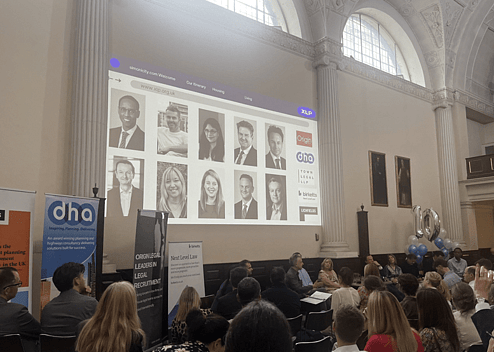
Simonicity 10 Years Time event - photo credit: Emily Tanzini-Hale
Landmark Chambers – London Planning Conference
Emily attended the Landmark Chambers London Planning Conference on 16th June. The programme was packed with topics from the London Plan, updates on the Building Safety Act, viability, plan-making, Tall Buildings, co-living schemes and build to rent, and insights on Green and Grey Belt land.
Many of the speakers were specialist planning barristers but there were also key insights from public and private practice across the city with presentations from Jules Pipe CBE (Deputy Mayor of London for Planning and Regeneration), Sasha White KC, Russell Harris KC, Neil Cameron KC, Rupert Warren KC, Matthew Reed KC, Jenny Wigley KC, Melissa Murphy KC, Heather Sargent, Joel Semakula, Rebecca Sage and Odette Chalaby (Landmark Chambers), Lindsay Garratt (Winckworth Sherwood), Stephen Black (CO-RE), Tom Dobson (Quod), Matthew Spry (Lichfields), Louise Samuel (Town Legal), Elva Phelan (Berkeley Group), and Rebecca Burden (London Borough of Camden).
The conference included a lot of speculation on the forthcoming NPPF and Draft London Plan, both anticipated to be published in July 2026. It was great to hear from Jules Pipes CBE, deputy Mayor of London, on his intentions for the new London Plan and how he has responded to the Draft NPPF in reducing the content of the plan and any duplication in national policy or other regimes.
The London Plan 2021 was drafted and scheduled for publication ahead of the 2020 change to the Planning Use Class Order. It will be interesting to see what the inclusion of the flexible Class E use in the London Plan will mean for businesses and high streets across the capital.
Other planning news:
The National Scheme of Delegation consultation outcome and statutory guidance was published by MHCLG.
Whilst the measures will come into force 31 October 2026, the guidance comes into force now and makes clear that councils need to make preparations to be ready from 31st October or could risk facing judicial review.
The Guidance outlines which applications will be delegated and the types which could still be determined by planning committee. The Guidance also contains limits for the size of planning committees.
Schedule 1 applications must be determined by delegation, and includes:
Householder
Minor residential schemes (1 to 9 dwellings)
Minor commercial schemes
Alongside conditions, some reserved matters, prior approval for permitted development, PiP, certificate of lawfulness, BNG plan etc
Schedule 2 applications would include full applications not included above (i.e. large schemes, residential schemes for 10+ homes), LBC, TPOs, ad consent and S73
Schedule 2 applications will only be determined by committee if there a significant planning matter was raised with regard to the development plan or other material consideration, or if there is a significant economic, social or environmental concern for the local area
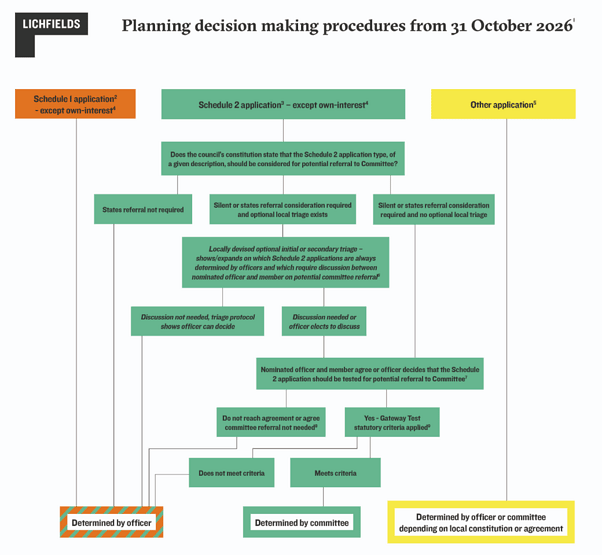
Image source: Lichfields
WEA Planning News:
Planning permission was granted for the amalgamation of 4 flats into 2 flats in a Conservation Area in the London Borough of Islington.
Certificate of Lawfulness was granted to confirm that a proposed HMO in the London Borough of Brent would be permitted development.
WEA Planning secured permissions for new or altered boundary treatment in Hackney and Redbridge.
Total planning barrister count in a single blog post: 14