How can planning help keep you cool?
This summer has seen record temperatures across London and air conditioning sales went through the roof. But do you know how planning can keep you, your home or your business cool?
Permitted development or planning permission?
The new provisions in the General Permitted Development Order (GPDO 2015) now means that some homeowners can install Air Source Heat Pumps (ASHPs) with both heating and cooling functions. If your machine is MCS certified or capable of achieving the relevant criteria, you could install an ASHP which both heats and cools with no planning permission required.
WEA Planning is working with homeowners to ensure that they comply with the permitted development criteria. If your property does not benefit from permitted development, WEA Planning can assist you in obtaining planning permission for Air Conditioning units or ASHPs.
Across the capital
The London Plan (2021) contains policies to reduce overheating in new developments.
The energy hierarchy seeks that development utilises passive cooling measures and improves air tightness before then permitting active cooling.
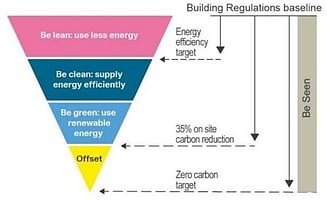
Image credit: GLA – Be lean; be clean; be green, be seen
Measures to reduce Urban Heat Island effect
Outside of the London Plan the Mayor of London launched a new Heat Plan for London in June 2026, establishing a vision to protect the capital from extreme heat.
The GLA also help Londoners to find cool spaces across the city with the Cool Spaces initiative and map. This map provides a list of cool public spaces for Londoners to escape the heat and keep safe indoors. The GLA also have a warm spaces map in winter.
Passive cooling
Blinds and external shading devices are gaining prominence across the city, and the planning guidance is starting to follow.
The Royal Borough of Kensington and Chelsea have produced RBKC Householder Greening Guides with detailed guidance on retrofit and topics including Air Source Heat Pumps, windows, shading, and flooding. The guidance on External Shading offers great examples, particularly for heritage buildings, and demonstrates that external shading can be not only acceptable in historic properties but can also reinstate lost original features.
WEA Planning recently secured planning permission for external shading for a homeowner in Camden to retrofit a locally listed building.
Other methods of passive cooling can include insulation, improving glazing, warm flat roofs, improving ventilation, and urban greening by increasing tree canopy cover, living roofs and walls, and using hardy drought-resistant planting.
Shade the UK publish research and advice to mitigate overheating, with temporary low-cost measures to permanent interventions in homes, offices and cultural venues.
When planning to adapt and retrofit an existing building it is important to understand the constraints and challenges of each property. WEA Planning can offer a Discovery Appraisal to help owners understand the site-specific planning constraints, designations and best approach to achieve a more sustainable property.
WEA Planning are working with property owners across the capital to keep buildings cool. Contact us today to find out more about our services.