Another part of the Government’s planning reforms came into effect in October. From 31 October 2026, a National Scheme of Delegation set out which planning applications must be decided by officers and which can be considered by a planning committee. The Government hopes the changes will make decision making more consistent across councils and speed up the planning process.
Here we explain what is changing, the response from councils, and what it could mean for planning applications.
Who decides a planning application?
When you submit a planning application, it is decided in one of two ways.
By a planning officer. This is a "delegated decision". A professional planner at the council assesses the scheme against local and national policy, considers any comments from neighbours and consultees, writes a report and makes the decision with sign off from the head of planning at the local planning authority.
By the planning committee. This is a group of elected local councillors who meet in public, usually once or twice a month. Officers still assess the scheme and write a report with a recommendation, but the councillors vote on the outcome. Applicants, objectors and ward councillors can often speak at the meeting though this is usually a limited time slot (typically 3 minutes).
Most planning applications are already decided by officers. Government statistics show that 97% of decisions made by district-level planning authorities in England were delegated to officers between April and June 2026. However, delegation rates vary between authorities. An analysis published by the Local Government Chronicle in April 2025 found that rates ranged from 70.3% to 99.9% across more than 300 planning authorities.
Until now, each council has set out in its constitution which planning applications are decided by officers and which are considered by a planning committee. These rules form part of the council’s scheme of delegation. In many areas, a ward councillor could “call in” an application to committee, or an application would be “called in” (referred to committee) automatically once it attracted a set number of objections. As a result, the same application might be delegated in one borough and go to committee in a neighbouring borough.
The ability to call in has resulted in lobbying of councillors from local residents and applicants. This has meant sometimes very minor applications are subject to the full rigour of a planning committee. This does cost resources as each meeting has to be hosted and more officer time is often taken up preparing for these committees.
Councils still have local arrangements under the new system, but these will need to comply with the national scheme.
What is changing?
The new scheme comes from the Planning and Infrastructure Act 2025. The detailed rules were made on 15 July 2026 and took effect on 31 October 2026. They split applications into two groups.
Schedule 1: must be decided by officers. These applications can no longer go to committee at all. They include:
householder applications, such as extensions, loft conversions and outbuildings
minor commercial applications
small housing schemes of one to nine homes on sites under 0.5 hectares
lawful development certificates, prior approvals, discharge of conditions and non-material amendments
Schedule 2: officers decide, unless a committee referral is agreed. This includes larger schemes (any planning application that is not a householder, minor commercial, or minor residential application), listed building consent, retrospective planning applications, advertisement consent and applications for works to trees protected by a Tree Preservation Order. These applications will normally be decided by officers, but may be referred to committee.
For a referral, a nominated planning officer and nominated councillor (normally the chief planning officer and committee chair) must agree the application raises an economic, social or environmental issue of significance to the local area, or a significant planning matter when considered against the development plan and other relevant considerations. This is known as the “gateway test”, and the Government expects referrals to be the exception.
Separate rules apply to applications involving an interest of the council, its officers or councillors, which can be referred without meeting the gateway test.
Three other changes are worth knowing:
Councillor call-in ends. Ward councillors can no longer send an application to committee themselves. Councillors may still be able to request that a Schedule 2 application is considered for referral to committee, depending on the council’s local procedure.
Objection numbers no longer trigger committee. The number of objections received will no longer automatically determine whether an application goes to committee. However, any relevant planning issues raised in those objections will still be considered as part of the assessment.
Smaller committees. Planning committees are capped at 13 councillors.
Neighbours, councillors and amenity groups can all still comment on applications in the normal way. Their comments, however, can no longer trigger an application being considered by the planning committee.
How have councils responded?
Councillors from across the political spectrum see the changes as a loss of local democratic control. The Local Government Association Conservative Group has also called on the Government to reconsider the changes, inviting Conservative councillors to add their names to a letter to the Prime Minister. The Town and Country Planning Association has also raised concerns that the changes will place greater pressure on planning officers, as communities have fewer opportunities to have their concerns heard at committee.
A handful of councils have gone further and voted against updating their constitutions. As reported on 21 October, these included Bolton, Tameside, Central Bedfordshire and Fenland. Other councils, including Derbyshire, Staffordshire and West Lancashire, have expressed opposition to the reforms but approved the required constitutional changes.
The Government's position is clear: councils cannot opt out. A council vote against the changes does not alter its legal obligations, and the national rules have been applied from 31 October regardless.
If a planning committee decides an application that should have gone to an officer, that decision may be challenged by judicial review and potentially quashed. There is also a potential risk of delay for applicants where councils have not put the necessary decision-making arrangements in place.
Other councils have welcomed aspects of the reforms. For example, in its response to an earlier consultation, Haringey Council welcomed a national scheme for the consistency and certainty it could bring. The Government’s response to that consultation also reported support from local authorities for the principle of a two-tier approach.
London
In day-to-day terms, London boroughs already work largely this way. Figures gathered by the London Forum showed that all but three boroughs (Camden, Ealing and Harrow) delegated 90% or more of decisions to officers, and 19 delegated more than 98%. For householder applications, the main change will be that a ward councillor can no longer request that an application is automatically considered by the planning committee.
The boroughs where it will be felt most are those that sent more applications to committee, and those with active ward councillors and amenity societies. Camden, for example, has been preparing constitutional changes to bring its arrangements into line. None of the councils reported so far as refusing to comply are in London.
There are a couple of points particularly relevant to London:
Conservation areas. Being in a conservation area does not, on its own, change how an application is categorised. Householder applications and qualifying minor residential schemes will generally fall within Schedule 1 and be decided by officers. Heritage considerations will still form part of the assessment. Some exceptions apply, including where an application is connected to listed building consent. Listed building consent applications fall within Schedule 2 and may be referred to committee if the relevant requirements are met.
The Mayor of London. The Mayor’s separate planning powers will continue alongside the national scheme. Applications of potential strategic importance will still be referred to the Mayor, who can comment, direct refusal or, where the relevant requirements are met, take over the decision.
What does this mean for your planning application?
For homeowners and smaller developers, the new scheme could provide greater certainty about how their applications will be decided.
More certainty for smaller schemes. Householder applications and qualifying schemes of up to nine homes will generally be decided by an officer, removing the possibility of a committee refusing the application against the officer’s recommendation.
Potentially quicker decisions. Applications decided by officers do not need to wait for a committee meeting, although decision times will still depend on the circumstances of the application and the council’s workload.
Working with planning officers. With more applications decided by officers, early engagement, a clear planning statement and a scheme that responds to relevant policies can help address potential issues during the application process.
Larger schemes still face scrutiny. Larger or more sensitive proposals may still be referred to committee if they meet the gateway test. Identifying and addressing planning issues early can help support the application, although it will not necessarily prevent a referral.
Applications already in the system. The new rules apply to applications awaiting a decision on or after 31 October, including those submitted before that date. This means an application previously expected to go to committee may instead be decided by an officer and the new rules are effectively operative already (a Planning Committee takes time to prepare for).
If an application is refused, your right of appeal is unchanged. The Government will review how the scheme is working by October 2028, so further changes are possible.
These changes will undoubtedly make a difference to smaller scale applications and the perceived democratic accountability.
It gives opposition parties are clear attack line by saying local communities and amenity groups are being shut out of the system.
In our own experience, we would see many proposals no longer meeting the criteria to be heard at committee and this is a good thing where the officer is recommending approval, and the committee ends up being a formality. In other cases, members can waste time overturning an obviously sound proposal that ends up in the appeals system.
On the flip side, we will see proposals that lend themselves to planning committee because of the genuine community benefits offered. These community benefits can occur at the smaller end of the spectrum and can be overlooked by officers who just see policy in black and white.
The New National Scheme of Delegation from 31st October 2026:
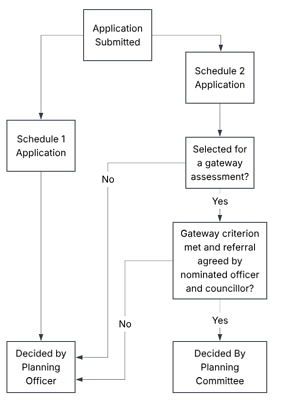
Schedule 2 applications are decided by officers unless referred to committee. Councils set local procedures for deciding which applications undergo a gateway assessment.
Gateway criteria: An economic, social or environmental issue significant to the local area, or a significant planning matter having regard to the development plan and other material considerations.
Exceptions: Applications involving an interest of the council, its officers or councillors can be referred by joint agreement without meeting the gateway criteria. Functions outside the two schedules follow local delegation arrangements.
WEA Planning are advising clients on the changes and the impacts for development proposals. Contact us to understand how the changes will impact your application.